As Mamas we want the best for our kids. We prioritise their needs above our own, constantly wondering if we chose the right school. Are they getting enough nutrition? Am I staying calm enough?
But what if one of the most powerful gifts we could give them was a ticket out of here?
Bus ticket, train ticket or plane ticket all offer the chance to experience change and see difference. Heck – even a road trip to a different town can be life-changing.
Travel offers a unique opportunity for children to grow in ways that no classroom or toy can match.
It‘s not “just a holiday“ - it's growth.
As a coach for mothers navigating travel with their children, and a travelling Mama myself, I’ve seen firsthand how quickly children develop these lifelong skills on the road.
In this post, we’ll dive into the benefits of travelling for kids, from emotional growth to increased adaptability and how you can harness the power of travel to raise more resilient, curious, and connected children.
The Science Behind It: Why Experiences Trump Things
Studies in psychology and youth development consistently find that experiences create more enduring well-being and developmental gains than material possessions.
Why? Personal experiences engage all the senses, create emotional connections, and spark curiosity — together forming lasting neural connections.
Research shows that people derive greater and longer-lasting happiness from experiences than from buying things, partly because experiences become part of our identity and are less likely to be compared unfavourably to what others have (Van Boven & Gilovich, 2003; Carter & Gilovich, 2010; Carter & Gilovich, 2012; Kumar, Killingsworth & Gilovich, 2014).
Travel connects children with the unfamiliar, the different, and the new. It’s in this zone that development happens. Children learn to tolerate the uncomfortable feelings of uncertainty and self-reflection.
Structured experiential learning — such as travel — has been linked to measurable, lasting improvements in children’s self-esteem, conflict resolution, problem-solving, and motivation to learn (AIR, 2005; Duerden et al., 2009).
Think about the first time you tried new foods, slept in a new bed, or saw people who looked and sounded different to you.
That’s real-life development.
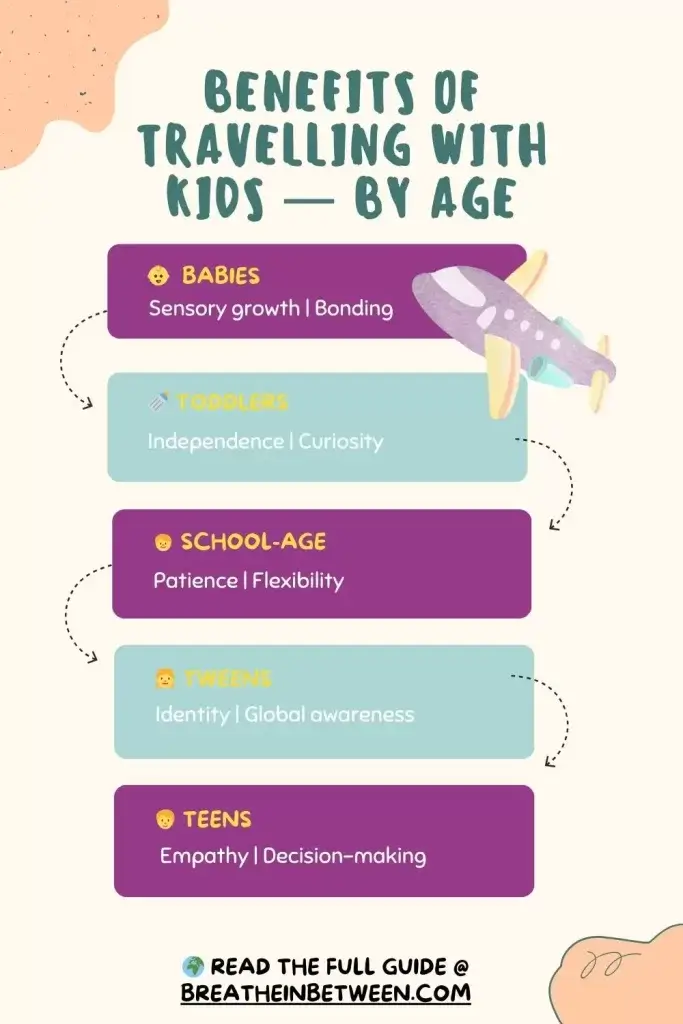
Benefits of Travelling with Kids at Any Age
In my view, there’s no “best age” to travel. Travel is always a gift to children’s development.
However, each age brings specific kinds of learning. Knowing these can help you plan a trip that won’t overwhelm your child, but will offer them both fun and development within their natural range.
? Babies
In my opinion, babies are the easiest age group to travel with.
As long as they have their parents, they’re usually not too fussed where in the world they are, so long as they can sleep, drink and cuddle.
However, travelling does not harm babies, so long as you are comfortable and confident to do it (trust me – I’ve heard all of the reasons why travelling with my babies was a bad idea!).
Travelling offers babies:
- Exposure to new sights, sounds, and environments, boosting sensory development.
- Adaptability, which begins to form through changes in routine and surroundings.
? Toddlers
While arguably the hardest age group to travel with, the learning opportunities for them on the road are many.
Yes, there may be a meltdown in exotic locations, but why not get yelled at away from home for a change?
Travelling with toddlers offers them:
- New sensory experiences, teaching them about the world around them: new sounds, smells, and textures.
- Allows them to test entirely new boundaries, exercising their new found independence.
- Opportunities to learn through imitation and observation in new contexts. Think new people, new customs and new languages.
? School-Age Kids
Children in this age group are already keenly aware of social norms, differences between groups and have a well-developed sense of what “normal” is.
Some benefits of travelling with kids in this age group are:
- Increasing their awareness of difference without fear. What’s normal for us isn’t normal for everyone and that’s ok.
- Building flexibility. Sometimes plans change while travelling. Sometimes things don’t go the way we hope. It’s all part of the adventure and for kids in this age group, it’s a wonderful way to learn these lesson.
? Tweens
Rapidly developing their own sense of identity and an awareness of global issues, travelling with tweens can support their:
- Increasingly strong sense of personal and group identity to become more nuanced. Who am I really?
- Ability to regulate themselves emotionally. Through exhaustion, exposure to difference, homesickness or whatever else comes up, travelling tweens will learn how best to manage themselves.
?? Teens
Whether they’re deep in their adolescent years or on the cusp of adulthood, this group of children are ripe to have their sense of empathy, self-awareness and decision-making potential developed through travel.
Travelling with Teens benefits them by:
- Deepening their self-awareness and sense of global citizenship. The impact of learning that they’re connected to people from around the world through living on this planet and sharings it’s resources cannot be understated.
- Developing empathy by seeing life through different cultural, religious, class and gendered lenses.
Supporting Emotional Growth Through Travel
Even the most intrepid travellers face challenges on the road. The smallest among us are no different. Struggles can include:
- Homesickness
- Culture shock
- Missing family and friends
But with a little planning, you and your children can smooth these bumps on the road.
For example, learning to name the feelings that they’re experiencing can start an open dialogue with you to discuss their experiences and connect these to their life more generally.
Maintaining small rituals from home while travelling, or co-creating new routines together on longer adventures can also support a sense of stability and safety, both of which are fundamental to your child’s emotional wellbeing and development.
Travel also provides you, as their Mama, with unique moments to model resilience, compassion, and adaptability to your little ones.
This isn’t just about seeing a new place, but about gaining a new perspective and a brand new set of skills.
Need some help supporting your homesick kid? Look no further.
How to Make Travel Developmentally Supportive
Even though travel has the potential to support your child’s development, it will take a little bit of preparation and planning from you.
Before the trip
Involve your kids in planning.
Talk to them about the differences that might exist in your destination compared to home, share pictures of your planned destination to set their expectations and show them on the map where they’ll be visiting.
Nothing makes my kids more excited ahead of a trip than running their fingers along the proposed route on the map.
During the trip
Keep some routines in place. For my kids, the same bedtime routine keeps us all on track, so that we can get a good sleep no matter where we are.
Another idea is to create a time of day to discuss your experiences. For example, over dinner you could each share the thing that surprised you the most about the day.
After the trip
Once you’re at home, don’t rush too quickly back into “real life”. Spend a little bit of time reflecting together over the first few days about the experiences that you’ve shared.
What did they love about the trip? When did they struggle? Is there anything they miss from the holiday location?
Tip: Pack a “comfort kit” with familiar snacks, small toys, and a family photo to help your little person feel at home on the go.
Take the Leap: Long-Term Adventures as a Family
Many parents dream of a longer family sabbatical—but hesitate. What about school? Work? Structure?
But what if this is the best time?
Extended travel deepens every lesson.
It slows you down, strengthens your family bond, and opens up a deeper kind of learning.
If you’re considering a longer adventure, start planning now. Your child’s development will thank you.
Need help? That’s what I’m here for!
After travelling for extended periods of time with my little ones and after nearly a decade in supporting families as a register Social Worker in two countries, I’m your go-to for questions about supporting kids on the road.
Travel is the Best Gift
Travel isn’t a break from life. It’s a part of life. One that teaches our children how to handle change, connect across differences, and see themselves as capable citizens of the world.
If you’re dreaming of a meaningful, stress-free family adventure, start with my FREE Emotional First Aid Kit for Travelling Kids—it’s packed with practical tips and emotional tools for parents of little adventurers.
? [Get the Free Family Travel Guide]
? Ready to go deeper? [Learn more about my online program for travelling families.]
? Research Behind This Post
- American Institutes for Research. (2005). Effects of Outdoor Education Programs for Children in California. Link
- Duerden, M. D., Widmer, M. A., Taniguchi, S., & McCoy, J. K. (2009). Adventures in identity development: The impact of adventure recreation on adolescent identity development. Identity: An International Journal of Theory and Research, 9(4), 341–359. Link
- Kumar, A., Killingsworth, M. A., & Gilovich, T. (2014). Waiting for Merlot: Anticipatory consumption of experiential and material purchases. Psychological Science, 25(10), 1924–1931. Link