
Planning a family trip is exciting, but too often we ignore our financial situation. It can feel boring, stressful or just overwhelming!
That’s why I created this Family Travel Budget Tool: a simple, practical way to keep your holiday planning realistic and your spending on track.
In this tutorial, I’ll show you how to use the tool step-by-step, so you can plan with confidence, track your spending, and enjoy your trip without worrying about coming home to debt.
If you haven’t yet, read
How to Create a Realistic Family Travel Budget You’ll Actually Stick To.
It explains why we need a budget (even though it can feel uncomfortable and boring!) and shows you how to budget for family travel in a way that’s realistic and flexible.
This post is all about putting that into action with your own family vacation budget template.
What You’ll Need Before You Start
Before diving in, gather a few basics:
- Your trip details (destination, dates, number of travellers)
- Rough estimates for flights, accommodation, and daily expenses
- A spreadsheet program (Google Sheets or Excel works perfectly)
- Optional: receipts from past trips to make your travel budget spreadsheet for families more accurate
Overview of the Tool
The Family Travel Budget Tool is designed to make planning simple and stress-free. At the top, you’ll add your Destination, Travel Dates, and Number of Travellers.
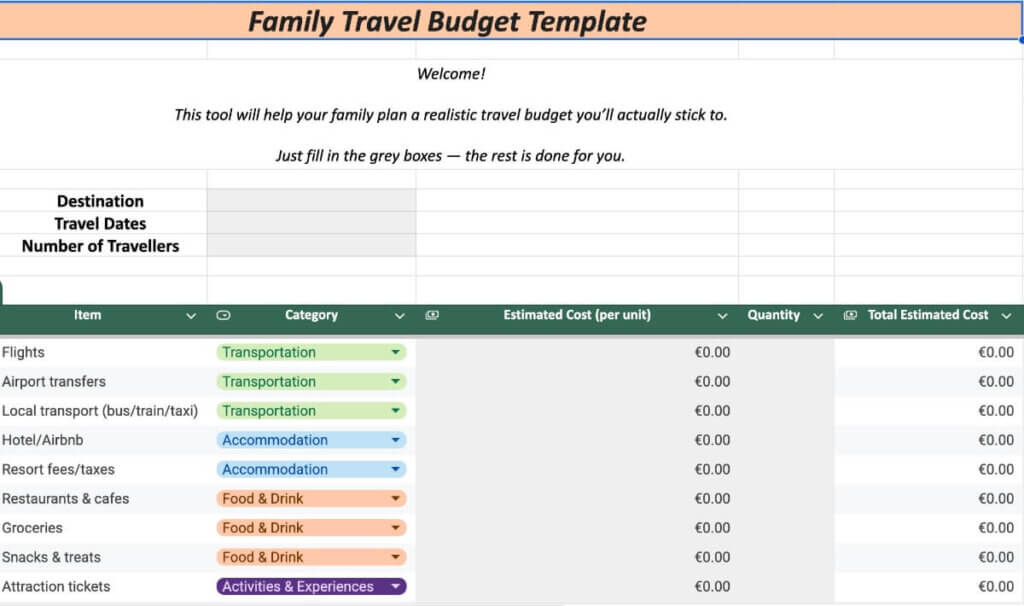
Below, you’ll see sections for common travel expenses like:
- Flights and transport
- Accommodation (including extra fees)
- Daily living costs (food, activities, local transport)
- Special one-time expenses (excursions, souvenirs)
- A contingency fund (your “just in case” money)
Each row has columns for:
- Estimated Cost (your best guess)
- Quantity (number of tickets, nights, etc.)
- Total Estimated Cost (auto-calculated)
- Actual Cost (what you really spent)
- Difference (shows where you over- or under-spent)
- Notes (space for reminders or details)
This is your family vacation budget template. It’s designed to be flexible, so you can customise it for every trip you plan.
Step-by-Step Walkthrough
Step 1: Enter Your Trip Basics
At the top of the sheet, fill in your destination, travel dates, and number of travellers.
This keeps everything organised and gives you a quick overview of your trip.
Step 2: Estimate Transport Costs
Scroll down to the transport section and enter your estimates. Examples include:
- Flights
- Airport transfers
Example: 2 adults and 2 kids flying to Berlin: €450 flights + €50 luggage fees.
Step 3: Add Accommodation Expenses
Enter nightly rates and the number of nights. Don’t forget extras like resort fees or local taxes.
To make this as accurate as possible, search on Airbnbor Booking.com for the dates you’d like to be at your destination. This way, you’ll know the real prices of various types of accommodation.
You’ll also figure out if there’s typically a minimum stay in that location (for example, bookings are only accepted if you stay at least 3 nights).
The sheet automatically multiplies rate × nights, so you don’t need to calculate.
Step 4: Fill in Daily Living Costs
This includes meals, snacks, public transport, and everyday activities. Estimate per day for the whole family, then multiply by your trip length.
To figure out how much things are in other countries, I usually Google the average price of bread. That’s an easy comparison for me to make with my everyday life here.
💡 Example: €60/day for 4 people = €420 for a week-long trip.
Step 5: Plan for Optional or One-Time Expenses
Add in those fun extras: theme parks, day trips, or souvenirs. Planning for them now means you’re not horribly surprised by the price at the gates (this was our experience in Thailand at a playcenter, but it was too late to say no!)
Step 6: Set Aside a Contingency Fund
Life happens! Add 5–10% of your total budget here for unexpected costs (missed trains, medical visits, or just spontaneous ice cream stops).
Your budget template will automatically show you how much you should set aside for this fund.
Step 7: Compare and Adjust
Once your estimates are in, look at your total.
- Is that final cost realistic for your family? Do you already have that money set aside, or can you reach that savings goal in the time you have?
- If not, where can you cut back? Does it need to be a shorter trip, or maybe you’ll travel later to get better deals on flights or accommodation?
- During your trip, enter actual costs to see how close you were.
The Difference column will automatically show if you overspent or saved in each area—great for learning and improving for next time.

Tips for Getting the Most Out of the Family Travel Budget Tool
Update as you go
Add real prices once you book flights or hotels.
This lets you see how much you’ve already spent so that you can adjust other expenditures accordingly.
Collaborate
Share your travel budget spreadsheet for families with your partner so that you’re both on the same page in terms of your finances.
This tool is a great way to start the sometimes sticky subject of finances.
Reflect afterward
Use the Difference column to plan smarter for your next trip.
How This Tool Links Back to Budgeting Strategy
In the main budgeting post, we talked about prioritising, setting realistic goals, and leaving room for flexibility. The Family Travel Budget Tool brings all that into practice:
- It helps you see where the money is going.
- It keeps your priorities for your family’s travel at the front of your mind.
- It gives you peace of mind that you’ve prepared for surprises.
Example: A family of 4 planning a week in Italy used this family vacation budget template to balance flights, accommodation, and activities while leaving €200 for unplanned fun—without exceeding their total budget.
Next Steps
- Download the Family Travel Budget Tool.
- Fill in your own details and start building your travel budget spreadsheet for families.
With this Family Travel Budget Tool by your side, you’ll feel more confident about your spending and more free to enjoy the moments that matter on your family adventures.