

The first three months after moving abroad… yeah, they can be really hard.
Not chaotic, not disastrous. Just heavier than you expected.
You might wake up feeling off.
Your child, who was so excited for this move, now refuses school.
Small tasks that used to take five minutes suddenly take an hour.
And you wonder:
“Am I the only one struggling this much?”
The good news is no, you’re not.
You’re just in the first 90 days of settling in. And honestly? That period matters more than most families realise.
The First 30 Days: Functional but Fading
The first month runs on adrenaline. Seriously.
You’re solving problems, learning systems, getting everyone where they need to be. You might even feel capable. Like this is easy.
But underneath, you’re starting to feel a rising sense of overwhelm.

Every interaction requires more mental energy than normal. Decisions feel harder. Your children are adjusting to new rules, sounds, and expectations.
It’s a lot.
In my first months of living in Germany, I was always exhausted and I couldn’t understand why. I felt like I hadn’t done enough to be this tired.
Looking back though, I can fully appreciate that every day I was competing in the mental gymnastics Olympics, just to get my ‘normal day’ done.
So, what can you actually do?
- Keep routines simple: pick one wake-up, breakfast, and bedtime rhythm. That’s enough.
- Track small wins: even finishing basic errands count. They’re harder now, so give yourself credit.
- It’s okay to be tired. Really. You’re doing a lot.
Days 30–60: The Emotional Dip
And then the adrenaline fades.
Suddenly, everything feels heavier. Slower. Harder.

Your child starts complaining about school. They cry over small things. They cling more than usual.
These are some of the most underestimated aspects of moving abroad with kids.
You might start to feel homesick. Maybe irritable. It might be now that the biggest questionof all sneaks into your mind: Was this the right decision?
My first 30 daysin Germany were so adrenaline-fuelled, exciting and new that I didn’t give myself any time to really consider the new life we’d started, what we’d left behind, and how I felt about it all.
The work started after the second month, even though I wasn’t ready for it. Prepare yourself. It’s coming for you, too.
What helps:
- Check in with your kids: Make just a few minutes a day 10 to ask “How are you feeling today?”. You might start to see a pattern developing.
- Give yourself mini breaks: Even 5 minutes just to breathe in silence and bring your heart rate down can be enough to make this transition easier to bare.
- Name your feelings without judgement: Are you homesick, tired, frustrated? They’re all normal and need no further explanation. You feel how you feel.
Days 60–90: Building Stability
Around month three, things might finally start to feel familiar.

You know the local supermarket and the best local products. Your kids recognise some friendly faces. Family routines start to feel like, well, routines again.
Your confidence as a parent, as a professional, as you? Slowly coming back.
If you’re one of the lucky ones who never lost their confidence in the face of all of this change, let me know your secrets, ok?
I’m still rebuilding myself, bit by bit, since our big transition five years ago. It’s happened for me in small steps, but the more I rebuild, the more I grow, slowly developing a new me. A better me.”
Practical things you can do now:
- Stick to predictable routines: meals, homework, bedtime.
- Celebrate small wins: a full school week done, a new friend made, one errand completed.
Focus on What Really Matters in the First 90 Days
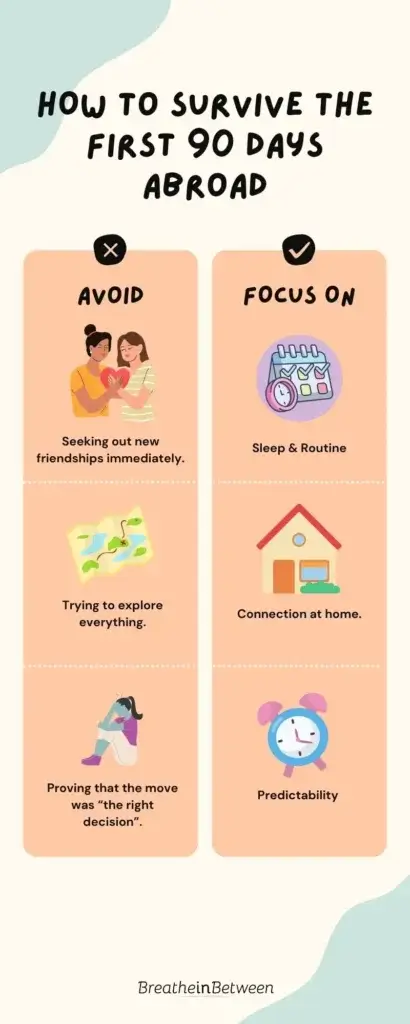
Most families try to do too much:
- Make new friends right away
- Explore everything
- Prove the move was the right decision
- Settle in overnight
Instead? Focus on stability:
- Sleep & routine > exploration
- Connection at home > performance outside
- Fewer commitments > overextending
- Predictability > spontaneity
Goal: keep your head above water. That’s it. Everything else can wait.
A Quiet but Important Reminder
Ninety days won’t make you feel fully at home.
But it will stretch you. Challenge you. Make you feel outside your comfort zone.
You’re working double time to support your kids emotionally while trying to hold onto yourself. That’s a lot.
It’s not weakness. It’s adjustment. Transitions are uncomfortable before they become stable.
And yes. Having support helps. Even a little guidance, a trusted voice, or someone who’s done it before can change everything.
You’re not behind, you’re adjusting.
Next Step for Extra Support
If you want practical guidance for your first month as a family abroad, grab my FREE Expat Starter Kit.
It’s designed to help families survive, stabilize, and thrive during those critical first weeks abroad.

Leave a Reply